SDS100 vs SDS150: Similarities, Differences, and How To Choose
The Uniden SDS100 and SDS150 are both high-end True I/Q handheld scanners with very similar core performance, but the SDS150 adds modern connectivity and ergonomic upgrades at a higher price.
Core similaritiesBoth radios share essentially the same receiver platform and coverage, so they will hear the same systems in the same locations under most conditions.
- True I/Q SDR architecture with advanced trunking support and excellent simulcast performance.
- Uses the HomePatrol database for the USA and Canada, stored on a microSD card, and can be programmed and managed with Uniden software.
- Similar frequency coverage, spanning common VHF, UHF, and 700/800/900 MHz bands plus 1.2 GHz.
- Water-resistant handheld form factor suitable for field use.
- Support for optional paid digital upgrades including DMR, NXDN, and ProVoice on both product lines.
- Color display, location-based scanning, close-call near-field capture, recording to microSD, and the familiar Uniden handheld menu style.
In real-world monitoring, users generally report very comparable sensitivity and scan speed, with any SDS150 improvements being evolutionary rather than dramatic.
Key differencesThe SDS150 is best seen as a modernized SDS100 with quality-of-life and connectivity features rather than a completely different radio.
Hardware and ergonomics- Built-in GPS on the SDS150 for automatic location-based scanning. The SDS100 requires an external GPS if you want that convenience.
- SDS150 adds Bluetooth for wireless audio and app integration. The SDS100 does not have Bluetooth.
- SDS150 includes a dual-slot charge cradle that can charge both the radio and a spare battery. The SDS100 relies on cable charging and optional external chargers.
- SDS150 uses a USB-C port, while the SDS100 uses an older USB mini connector.
- Both have a customizable color display and similar interface.
- Users often note slightly faster boot times and some refinements to squelch and overall feel on the SDS150, though everyday performance is broadly similar.
- The SDS100 has Waterfall as a paid option while the SDS150 comes with it included in the base price.
- The SD Card on the SDS150 is accessed under a rubber flap, the SDS100 requires the battery to be removed to access it.
Performance and feel- Both models are strong performers on simulcast and weak-signal work. Side by side, the SDS150 can sometimes lock and decode a bit more cleanly on specific systems, but the difference is incremental.
- The waterfall display on the SDS150 makes band exploring and hunting for unknown or intermittent signals easier and more engaging.
- There are multiple reports that the SDS150 has superior UHF and VHF performance over the SDS100.
Pricing and positioning- The SDS100 typically sits at a lower price point and has been the long-time gold standard Uniden handheld.
- The SDS150 is marketed as the new flagship handheld, with a price typically several hundred dollars higher than the SDS100.
- The SDS150 is positioned more as a successor or replacement to the SDS100 than as a completely separate tier.
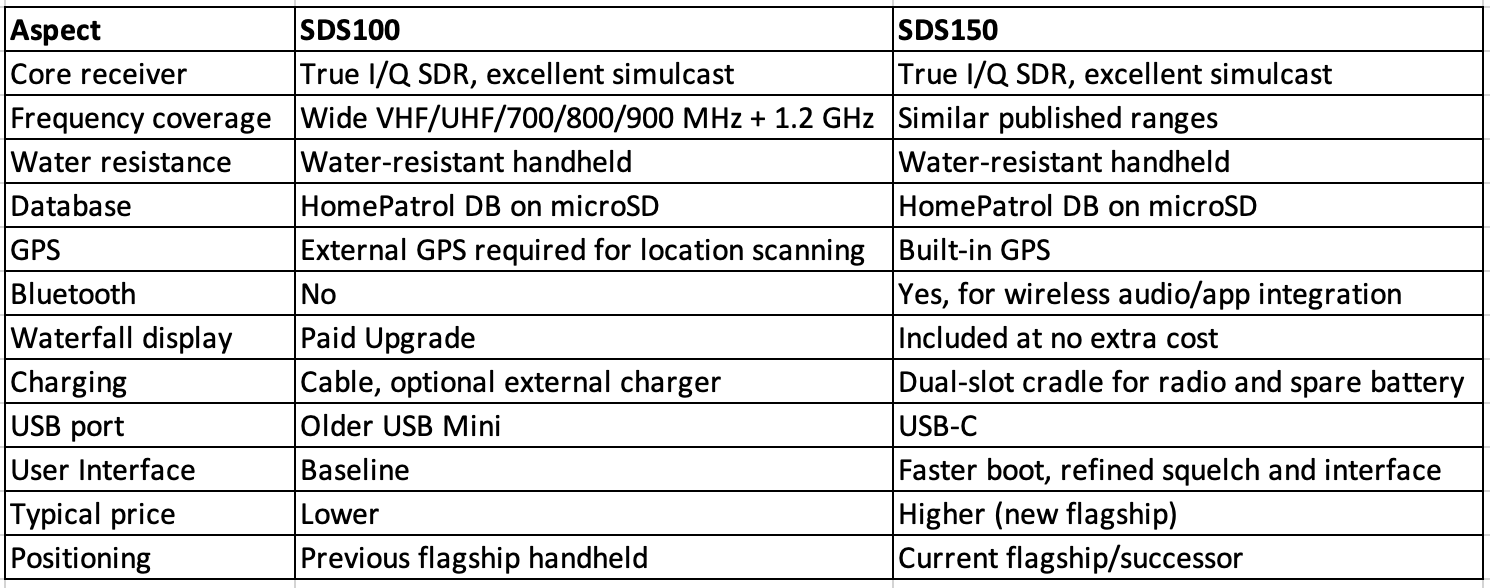
SDS100 vs SDS150 at a glance![]()
Additional at a glance notes:- Note that the Waterfall display is a paid option on the SDS100 while the SDS150 includes it.
- The USB Connector for the SDS100 is a USB Mini for charging and programming, a second USB Micro port is present for power only (no charging or programming).
You can think of the SDS150 as adding convenience, integration, and modern hardware touches on top of the same basic receiving capability found in the SDS100.
Choose the SDS100 if:- You mainly care about core P25 and simulcast performance and do not need built-in GPS or Bluetooth.
- You are price-sensitive and would rather invest the savings in paid digital upgrades, antennas, or a second radio.
- You already have a comfortable workflow for programming and are fine without a waterfall display or app tie-ins.
Choose the SDS150 if:- You do a lot of mobile or field monitoring where integrated GPS and an included cradle with spare-battery charging are a big operational benefit.
- You want Bluetooth for wireless audio or tighter integration with phone or tablet apps as part of your monitoring setup.
- You frequently search for new or unknown frequencies and will make real use of the waterfall display to visually spot activity and weak signals.
- You are willing to pay extra to get the current flagship with USB-C, faster booting, and more polished ergonomics.
Practical rule of thumb: if you primarily monitor known systems from one area and want the best value, the SDS100 is usually the smarter buy. If you travel a lot, run the radio mobile, and will actively use GPS, Bluetooth, and the waterfall, the SDS150's added features are likely worth the premium.